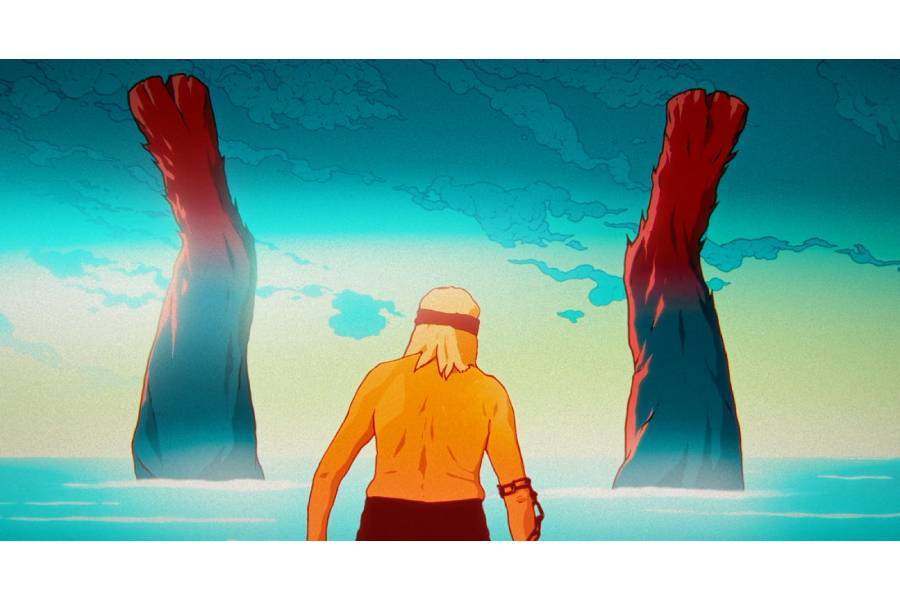
In the context of animation, Latvia’s name has become something of a brand - one that brings together radically different authors, styles, and audiences. Over the past four (!) years, three Latvian animated feature films have reached the top tier of European Film Academy nominations: Signe Baumane’s My Love Affair with Marriage (2022), Gints Zilbalodis’ Flow (2024), and now Dog of God, which marks Lauris and Raitis Ābele’s debut feature-length animation. Created using rotoscoping, with comic-book visual waves and bravado contributed by artist Harijs Grundmanis, the film is an example of animation made for adults.
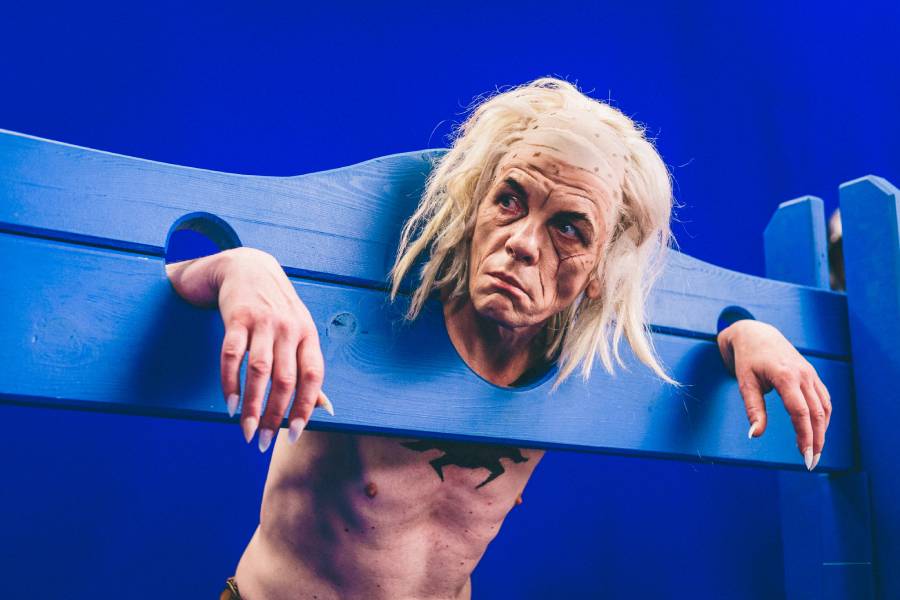 Drawing on folk songs, folklore stylization, horror cinema, and adult fairy tales, the screenplay by Ivo Briedis and the Ābele brothers is a heretical response to The Decameron. Dog of God brings together a baron tormented by fertility and potency problems, homemade phalluses, a priest who leaves his good mood behind in the church vestibule, the hungover and the devout, an alchemy-loving bearded woman, mealworm caviar, excess in every sense, secrets - falling from the heavens, from bodies, and from whatever hole they choose - devil’s eggs (a refined nod to the brothers’ award-winning short Castrated Boar, 2014), and a grey-haired werewolf bearing the likeness of Latvian ex-prime minister Einars Repše, as well as references to the Livonian werewolf Thiess recorded in a 1691 court case in the Cēsis region.
We speak shortly after Lauris’ return from the United States, where he was actively working on the Oscar campaign and meeting with members of the Academy of Motion Picture Arts and Sciences. Meanwhile, Raitis shows forecasts from Next Best Picture, which are updated regularly - and there, among Hollywood big-budget productions and French animation, Dog of God sits comfortably in tenth place in the Best Animated Feature predictions.
The film has already screened at more than 50 festivals, including Tribeca, London, Sitges in Spain, and others. As the filmmakers themselves note, audiences in different countries and contexts perceive it differently. In Latvia, however, they are gradually observing a growing trust in local animation - even if the provocative and unsettling Dog of God is far from a familiar or comfortable viewing experience. Lauris sees purpose in this: Latvian cinema must have teeth. Sharp teeth. And Dog of God is proof of that.
Click HERE to watch the trailer.
Brothers Lauris (45) and Raitis (42) Ābele on the juiciness of folk songs, the festival circuit, and the freedom to create art for art’s sake
Dārta Ceriņa:
More than ten years have passed since Castratus the Boar (Grand Prix Tampere 2015), the short film you made together. Looking back from Dog of God, the Oscar campaign, and the European Film Awards, what moments stand out as the most important steps along the way?
Raitis Ābele:
The Tampere Film Festival was a turning point and a period of experimentation. We were forced to start traveling to film festivals.
Lauris Ābele:
We traveled a lot at that time.
R.Ā.:
We learned what a film festival actually is. Before that, our idea of festivals came from Arsenal and Baltic Pearl - going to see “strange films.” After one year on the festival circuit, we realized it was an entire world with its own rules and people who gather in one place. Feature films operate on completely different principles, of course, but that’s when we became aware of the scale of this cosmos.
L.Ā.:
It’s an industry. Tampere is an A-class short film festival. We realized we had to live practically. Now we joke that you’re lucky if you manage to watch any films at a festival, because it’s primarily a platform where you go to work. The industry section - which runs quietly in the background at festivals - was new to us. Producer Toms Palmers taught us how things are done. We suddenly saw that this parallel world exists.
R.Ā.:
People came up to us after screenings and handed us business cards. Someone gives you a card, you put it in your pocket, have a beer - and the next day you have no idea who it was. Or why.
L.Ā.:
After winning an award, even more people came to introduce themselves. Later, Raitis and I would sort through the cards and think: was that the weird one we shouldn’t talk to? Or the one we should? Which one goes in the left pocket, which in the right? (Laughs.)
R.Ā.:
Then someone advised us to write notes on the back of the card - who to send a screener to. Otherwise, the amount of information is overwhelming.
I just spent seven days at the Tallinn film festival and didn’t see a single film. (Laughs.) There were Series Mania seminars on TV series, and the schedule was extremely dense. I didn’t even attend a screening of Dog of God in Tallinn.
D.C.:
You mentioned experimentation. Would you call Dog of God an experimental and daring film - or simply a film that had to be made?
L.Ā.:
Dog of God is the kind of cinema we send to each other and recommend. It can be anything - live action, animation, or something else that redefines things. We don’t recommend films that aren’t worth seeing. For example, I can say that Ridley Scott’s Gladiator II (2024) is not worth watching. I went, watched it, and regretted the time I wasted, because there are so many other 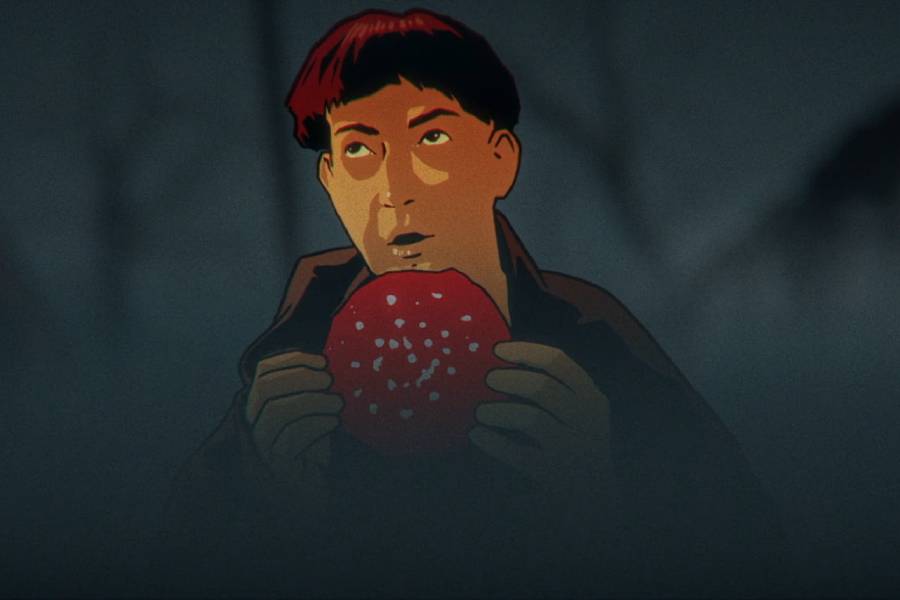 interesting films I’d rather see. When we recommend films to each other, they’ve passed a certain evaluation. We like cinema that surprises us.
I like to define it as anti-narrative cinema - something that refuses traditional storytelling. You can’t really explain on paper what the film is about. What matters is the experience it gives you. Epic stories still exist, of course, but in a time when everything is calculated - starting with Netflix and so on - it becomes absolutely boring. I think people will soon get tired of that, which is why we’re seeing more anti-narratives. People don’t want to predict what will happen. You can exploit that for a while, but eventually it becomes exhausting.
D.C.:
Now there are “verticals” - short-form series and their platforms.
L.Ā.:
In America, people talk a lot about how this makes audiences dumber. Dialogue and plots are designed so everything can be understood on a small phone screen. Everything is optimized to hold attention and make you want to watch the next episode. You can accept it as light entertainment, but it has nothing to do with art.
R.Ā.:
I found it interesting that people once said something similar about music. In the 1970s, if you wanted to listen to music, you needed money. You had to be educated, successful, and able to afford a stereo system. Then you also needed money to buy a David Bowie record. That listener had gone through a process - jazz musicians, guitarists, recording quality. The listener was demanding.
Today, twelve-year-olds - and even younger - generate the biggest cash flow and clicks in music streaming, and music quality adapts to its audience. Audio equipment no longer costs much.
L.Ā.:
Standards have dropped - we now listen to music through tiny speakers.
R.Ā.:
Of course, great music still exists. But the supply is immeasurable, and we see the same tendency in cinema.
D.C.:
And Netflix - which doesn’t mean there aren’t a few good films every year.
R.Ā.:
Yes, but they’re not the whole picture. They attract good directors by saying: how can you not watch this? With vertical videos, audiovisual content adapts to younger viewers. In a way, I think of these videos as what we watched in the ’80s and ’90s - soap operas where you couldn’t tell who was whose son. Still, David Lynch and others won’t disappear.
L.Ā.:
The big-screen experience matters. There are studies showing how our brains react to large images. Czech artist Alfons Mucha painted monumental Slavic epics on massive canvases. Our brains focus on large images, but physiologically we pay less attention on small screens. Maybe some oligarch has a home cinema, but on a laptop we simply won’t get that experience.
D.C.:
Which brings us back to Dog of God.
R.Ā.:
During COVID we received additional EU funding for the film as an experimental project. That allowed us freedom. Together with artist Harijs Grundmanis we decided we could be free. We participated in the European Genre Forum - a year-long program - where we were told that we were making animation for adults who have seen everything. That meant there were no boundaries: if we went modest, no one would expect it.
L.Ā.:
Modesty irritates me. I like cinema that is both ambitious and contradictory - maybe even bad or good - but the idea is what attracts me. We ourselves feel that the film is even slightly modest, because Japanese animation in the 1980s was absolutely graphic, insane, and indescribable - those films are controversial.
R.Ā.:
We were told: everything is open. But when everything is possible, it becomes difficult, so we set limits. We accepted the sixth volume of Latvian folk songs as our framework.
L.Ā.:
Much of the film exists in silhouettes - there are only a few graphic elements.
R.Ā.:
Nothing is brutal. Not a single thing in the film is brutal - we stayed within the humor and aesthetics of naughty folk songs. Interestingly, some folk songs themselves are more explicit than Dog of God. That’s fascinating: Americans tell us after Tribeca that something like this would be impossible in the U.S. They envy Europeans for this freedom. Meanwhile, we look at America and think: you can do anything.
D.C.:
Different sides react differently.
L.Ā.:
Their system is so commercial that experimental films are rare. They can’t afford art for art’s sake anymore. That’s why we must thank the Latvian Film Centre and its expert committee.
D.C.:
How did you ultimately arrive at animation?
R.Ā.:
Lauris has heard this story. While we were working at Tritone Studio on Ilze Burkovska-Jacobsen’s My Favorite War (2020), we helped with pipeline development - task distribution, workflow, how assignments move from the director to project managers and animators, how seconds of animation come back. Gints Zilbalodis had never worked in a studio before, and Matīss Kaža had no animation experience. At one-point Matīss asked me to help with Flow.
I said I was afraid to join alone, so I invited my cousin Nauris Ašenkampfs to help design the logistics of how Gints could work in a team. In the end, we failed. But Gints learned to work in a team - which is also one of Flow’s core themes. During that time, I was immersed in animation, and Dog of God’s script was right next to us. We asked our friend and artist Harijs Grundmanis to sketch a few ideas. That was the moment Lauris and I realized: this could work. Harijs gave us what we were missing. We had a script and were pushing it as a live-action film, but something was lacking all this time…
L.Ā.:
…to ignite it. Nostalgia for childhood comics also played a role. We drew comics as kids - pure framing, really. We used graph paper notebooks and drew everything with rulers. Each brother had his own notebook, and our mother, an artist and architect, encouraged us to draw. We’ve since let our hands rest, but in Dog of God it’s Harijs’ aesthetic - with our scribbles inside it.
D.C.:
I find it extremely symbolic that in the past four years, three Latvian animated features have been nominated for European awards - and they don’t compete with each other at all.
R.Ā.:
…and we have the smallest animation funding in the Baltics.
And even more so in Europe, where we’re held up as an example in animation. We’re sometimes even called a major power - which is no longer an exaggeration.
L.Ā.:
During Riga IFF, a Lithuanian studio representative told us they were happy about Flow: Latvia is once again an animation powerhouse. Estonians say the same - “you have animation.”
R.Ā.:
It’s interesting, because Estonians have consistently worked in animation - they have a school, a style, authors. They even have animation in higher education. And then Latvians come along with their strange approach… But everything is great. Estonian colleagues say they consider Flow “their film.” We’re happy for them - and we collapse laughing.
L.Ā.:
The Baltics are now on the cinema map. People from Romance-language countries can distinguish Latvia from Lithuania. They used to mix us up - now they know.
D.C.:
 You’re with Dog of God are now recognized worldwide - festivals in New York, London, Tallinn, even Australia - but what about Latvian audiences? Is Dog of God understood? Do you feel seen?
R.Ā.:
We’ve been away from Latvian screenings for a while because of the European Film Academy and Oscar campaigns. We’ll reconnect soon. Adult animation is harder to bring to cinema audiences than children’s animation. But thanks to Flow, people are coming to animation - including Dog of God.
L.Ā.:
I have an anecdotal hope. Maybe one day we’ll look back and say: Latvia has cinema with teeth. For me personally, it started with Aik Karapetjan and Samuels Travels (2022), Touched by Eternity (2024) by Marcis Lācis, and now Dog of God. These are films that speak to me - like Lars von Trier says, a film should be as uncomfortable as a stone in your shoe. I agree. It’s cinema that doesn’t reproduce values, but throws you into another territory.
We no longer watch Dog of God with audiences at festivals - so it doesn’t wear us out - but we know it’s perceived differently across countries. The film has several narrative layers: Ivo Briedis developed the central dramatic line, and we added symbolism and mischief. Each viewer latches onto a different line. At Tribeca, people laughed exactly where intended. Laughter is the only thing you can reliably track - but Q&As confirmed people enjoyed the film.
R.Ā.:
Latvian audiences watch it more seriously.
L.Ā.:
Slovenia was similar. London laughed - the screening was sold out. We wondered: who goes to a film like this at 10:30 a.m.? Yet there were no seats left. People even approached us on the street asking for tickets. A woman came out and thanked us - very British - saying she had a hangover, but it disappeared during the film. “Brilliant cinema!” (Laughs.)
At early Latvian screenings, the audience was older. I thought they’d hate the film. But I was surprised - they spoke thoughtfully about sexuality in wedding rituals and how Christianity entered Latvia. I expected accusations of blasphemy. Instead, the opposite happened.
Latvian audiences are historically oriented toward serious themes - entertainment hasn’t fully taken hold yet. People focus on different layers. It depends on which line you trust - and how deeply.
Latvia hasn’t had historical fantasy films where Latvians aren’t heroic. Usually they’re straightforward heroic narratives.
L.Ā.:
Our film doesn’t have a single positive character.
R.Ā.:
Some critics, including Ilmārs Šlāpins, said we rely on clichés - like a shepherd stepping into cow dung to warm his feet. But that’s something our grandmother told us as children. It’s in literature. These details trigger memory - they’re closer to Latvian audiences than to foreigners.
Tribeca programmer Jonathan Penner said: in the first minutes someone tears off genitals, steps in shit, urinates - and he stopped the film after five minutes. Programmers usually decide in five minutes. He said: “This is insane. No - I have to keep watching.” Clearly, it worked.
L.Ā.:
We’re often asked to explain scenes. Not everything should be explained - otherwise it becomes naive - but people are curious. We try to explain to journalists and critics. For example, the cat scene: in Latgale there’s a saying, “go kiss the cat’s asshole.” In Kurland they say, “blow into my ass,” meaning “go away.” Some women even lifted their skirts and showed their bottoms.
D.C.:
If you wanted it juicy - here it is.
R.Ā.:
One saying from my grandmother on my mother’s side: if a goat has no milk, then it has no milk - lift its tail and pour it back in.
L.Ā.:
Absolutely. What German lords once disliked is precisely this: folk songs are entirely pre-Freudian. There are no sexual taboos. That defines us. Sometimes I reread them - they can be exhausting, but they’re amusing and brutal. And they are part of Dog of God.
By Dārta Ceriņa / “SestDiena”