The discussion explored the role of film in addressing socially sensitive issues, including violence, pollution, war legacies and trauma. Speakers also focused on the contribution of EU programmes, particularly Creative Europe, to project development, coproduction, professional mobility and audience outreach.
Luigi Soreca, Ambassador of the European Union to Bosnia and Herzegovina, opened the panel by stressing the ability of culture to overcome divisions.
“Culture knows no prejudice and no borders. That is why our programmes, such as Creative Europe, Erasmus+ and other support initiatives, are excellent tools that help the integration process,” Soreca said. “Film and culture have a unique power to challenge prejudice, offer different perspectives and build genuine bridges across borders. This region has exceptional filmmakers, musicians, artists and writers, and I would say that creativity is its best ambassador.”
Zoran Galić, founder of the Sarajevo-based production company Vizart Film and former head of the Creative Europe MEDIA Desk in Bosnia and Herzegovina, said that film remains a particularly strong medium for confronting complex stories.
“When we want to tell major stories, there is no better medium than film,” Galić said. “The responsibility is to be true to yourself, to express yourself in the best possible way, to remain open to others and to be brave. In the Balkans, it is not always easy, as the same event can be viewed from many different perspectives. But telling stories from every side helps society and culture to grow.”
Serbian producer Snežana van Houwelingen, founder of This and That Productions, noted that Creative Europe’s value extends beyond financial assistance. Its networks, training opportunities, workshops and exchange of expertise are important for emerging filmmakers who need time and contacts to develop projects.
“The EU is doing everything it can, but the problem lies with national funds. No country in the region has a healthy national system of support for young creative professionals,” van Houwelingen said.
She also argued that socially engaged filmmaking needs to be followed by wider public action. Referring to her experience with a film tackling peer violence, she said that social impact cannot be achieved simply through a screening.
“It is one thing to make a film about a socially responsible subject, and quite another to truly try to change something in society. Screening the film is not enough. Further activities, discussions and campaigns are needed,” van Houwelingen said.
Ishak Jalimam, producer at Realstage Productions and head of CineLink Industry Days at the Sarajevo Film Festival, referred to The Sky Above Zenica, a documentary on industrial pollution in Zenica. He said the project showed that films can raise awareness and help shape the public response to urgent issues.
“Film has the potential not only to raise awareness, but also to become an instrument of change. But this is a process, and it does not end with a screening,” Jalimam said.
Jalimam added that Creative Europe has encouraged filmmakers from the region to think about their audience, distribution, company sustainability and green practices from the earliest stages of development, rather than only concentrating on financing and completing production.
Montenegrin writer and director Ivan Marinović said that international collaboration is not optional for creators from small countries with limited film-industry capacities.
“A film project takes years to develop, and quality depends on having that time. You can see when something has been rushed. This programme gives you oxygen to survive that period,” Marinović said. “It immediately connects you with a wider network, gives a project credibility and makes it easier to build a coproduction.”
The speakers highlighted the Sarajevo Film Festival as a key regional platform for film projects at different stages of development. Through CineLink and its other industry activities, the festival supports projects before production, links filmmakers with international professionals and contributes to the creation of regional coproductions.
By Marina Lazarevska, reporting from Sarajevo
21-08-2026
EU With YOU Panel Highlights Creative Europe Opportunities at Sarajevo Film Festival
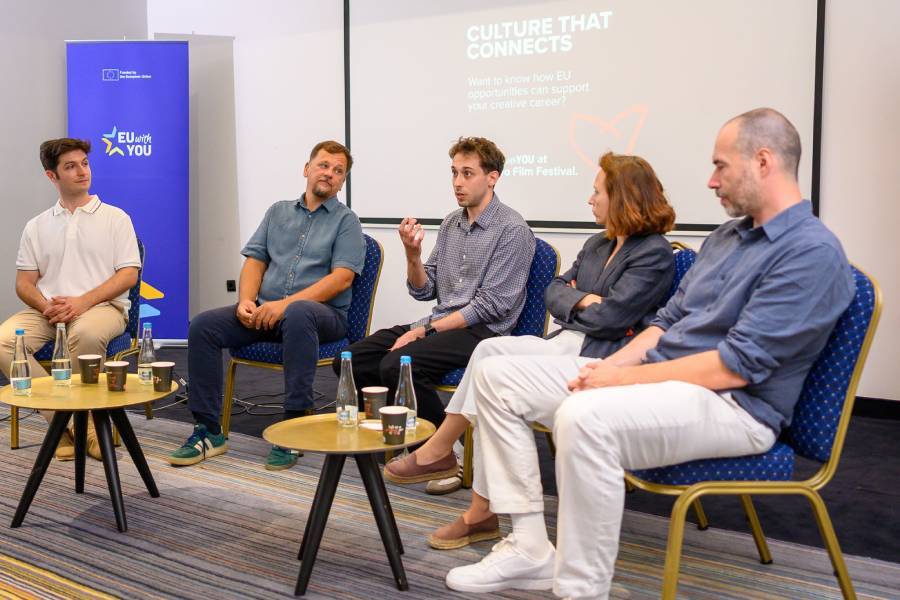 credit: Sulejman Omerbašić
Filmmakers, producers and EU representatives discussed the role of Creative Europe in supporting young creative professionals and strengthening regional cooperation during the panel “Culture that Connects – European Opportunities for the Creative Industries” at the Sarajevo Film Festival, which runs from 14 to 21 August 2026.
Published in
Press releases