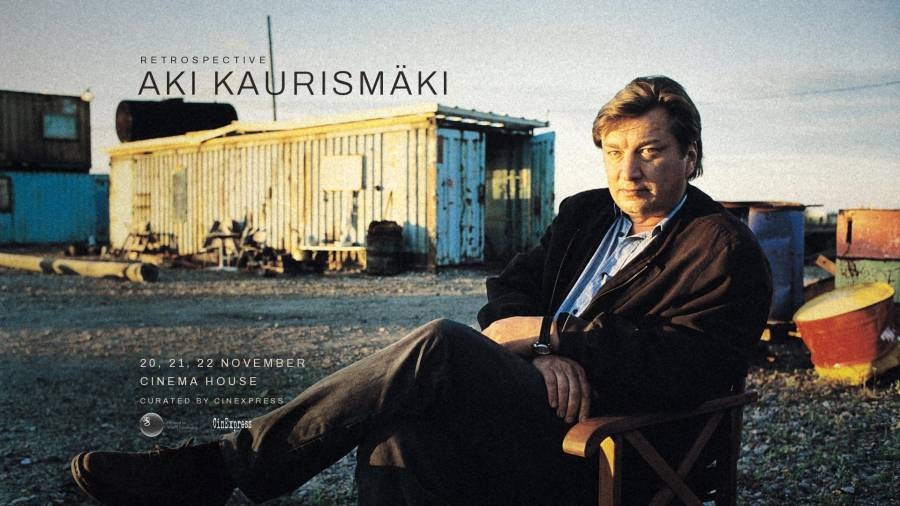
The screenings will take place on 20, 21 and 22 November in the Blue Hall of Cinema House (Tbilisi, 2 Kakabadze Brothers Street). Admission is free.
The films will be screened in their original language with Georgian and English subtitles.
The films are provided by the Finnish Film Foundation.
Curators of the retrospective: Nini Shvelidze, Giorgi Javakhishvili, Alexander Gabelia.
Aki Kaurismäki is one of the most distinctive auteurs of contemporary European cinema – a “romantic hooligan”, as he is often called. His cinema is at once restrained and emotional, pessimistic and optimistic, realistic and fairy-tale-like. His unique cinematic language combines minimalist form, dry and often absurd humour, and a humanist outlook.
A static camera, laconic dialogue, long pauses, rigorously composed frames, vivid colours, old cars, bars, working-class neighbourhoods, jukeboxes, tango, rock ’n’ roll and the heroes’ best friends – dogs – together create a world often called “Kaurismäki’s world”, or Akiland. Akiland is a stylised space slightly removed from reality, where time seems to have frozen somewhere between the 1930s and the 1980s. For years, the director’s main filming location has been his homeland, Finland. On the one hand, his films quote Finnish images, spaces and everyday life; on the other, they leave the viewer between two questions: does Kaurismäki’s cinema shape the face of Finland, or does Finland shape Kaurismäki’s cinema?
About the Director
Aki Kaurismäki was born in 1957 in the Finnish town of Orimattila. His friendship with cinema began at an early age and later grew into genuine cinephilia. Together with his elder brother, Mika Kaurismäki, he was a regular at the Finnish Film Archive – his personal record exceeded five or six films a day. This intensive self-education became a kind of film school without a film school: watching films, reading, film criticism and life experience laid the foundations of Kaurismäki’s cinematic vision.
In the early 1980s, Aki Kaurismäki and his elder brother Mika became actively involved in film production. The brothers founded their own company, Villealfa Film Productions, whose name echoes Jean-Luc Godard’s Alphaville. The name reflects the nature of their cinematic world – a love of cinema that is at the same time ironic and independent. Nor did Kaurismäki’s professional experience end there. Over the years he has worked as a film critic, director, screenwriter, actor and producer, and in 1986 he co-founded the legendary Midnight Sun Film Festival.
Although he never received a formal film education, he studied media at the University of Tampere. This experience returns as a peculiar refrain in Kaurismäki’s films: his characters’ lives often unfold against the backdrop of international news heard on the radio or television (the crackdown on students in China; executions in Congo; the demolition of a migrant camp in France; Russia’s war in Ukraine). Wars, political violence and tragedies in distant countries are part of everyday life – as if history always happens somewhere far away, yet its echo reaches even the rooms and kitchens of the most “ordinary” people.
After university came the “real life” that would prepare him for cinema. At various times he worked as a postman, a dishwasher, a labourer and in other manual jobs. This experience is the foundation of his cinema – a kind of rehearsal for his future trilogies about the Finnish working class, losers, port cities and migrants… In Kaurismäki’s films, workers and people from the lower social classes are never abstract social heroes: they are extensions of the Finland the director came to know first-hand while working in the 1970s, and of the people he met in everyday life in his youth.
Style and Signature
The particular character of Kaurismäki’s cinema is born where many kinds of experience intersect: a deep knowledge of classical cinema – from Chaplin and Keaton to Vigo, Bresson and Ozu – self-education, a love of literature, a critic’s eye, and lived experience among ordinary people. That is why his films are at once extremely stylised and everyday – as if the entire history of cinema and the human condition were captured in a single short, calm shot steeped in dry humour.
His heroes are often people left on the margins of social reality – workers, the unemployed, migrants, alcoholics, the homeless and outcasts. Like Chaplin’s heroes, they are shut out by the modern system again every time they try to cross a threshold.
“Who is beautiful anyway? Bruce Willis? I find him ugly. Terribly ugly… So I’ll stay with my ugly ones,” says Kaurismäki. This ironic manifesto reveals one of the key choices of his cinema: instead of ideal, glamorous faces, the director chooses people whom cinema and the world have marginalised together. Yet his loyalty to his characters never turns into a claim to directly correct social reality. For Kaurismäki, cinema is a space of resistance, human connection and compassion.
“The more pessimistic I am about the state of the world, the more optimistic my films become.” Aki Kaurismäki does not hide his scepticism about the world, yet in his films he consciously resists pessimism. “My secret aim has always been to make films that leave the audience at least a little happier when they walk out of the cinema than when they came in.”
This is where the special tone of his cinema emerges: against a backdrop of almost Beckettian hopelessness about the world, Kaurismäki holds on to a stubborn faith in love. His heroes may be poor, unemployed, defeated or cast out by society, but they are still capable of helping one another. This small human gesture – compassion and mercy – becomes, in his cinema, the possibility of a great utopia: universal solidarity.
Programme by Day
20 November, 19:00 – Le Havre (2011)
The first film of the “Port City Trilogy” and winner of the FIPRESCI Prize at the Cannes Film Festival.
One of Aki Kaurismäki’s most humanist films, it tells the story of Marcel Marx, a shoeshiner in a French port city, who hides a young African migrant boy from the police. A small group of people gradually gathers around him, and for them helping another person becomes a matter of solidarity and human dignity.
21 November, 15:00 – Drifting Clouds (1996)
The first film of the “Loser Trilogy”, which premiered in the main competition of the Cannes Film Festival.
Against a backdrop of unemployment and economic crisis, restaurant manager Ilona and her husband Lauri both lose their jobs. Kaurismäki presents the crisis in their lives not as the absolute dead end of a social drama, but as an opportunity for human connection and a new beginning.
21 November, 17:00 – The Man Without a Past (2002)
The second film of the “Loser Trilogy”, winner of the Grand Prix at the Cannes Film Festival.
A man arrives in Helsinki, is attacked and loses his memory. Left without his name and his past, he begins a new life on the outskirts of the city. A film about identity, memory and human solidarity, it is one of Kaurismäki’s warmest and most ironic works.
22 November, 15:00 – The Match Factory Girl (1990)
The third and final part of the “Proletariat Trilogy”, which received an Honourable Mention for the OCIC Award at the Berlin International Film Festival.
A lonely young woman works in a match factory and lives in a monotonous everyday world. Against the indifference of her family and society, her life gradually turns tragic. Shot almost entirely without dialogue, the film is one of the clearest examples of Kaurismäki’s minimalist cinema.
22 November, 17:00 – Fallen Leaves (2023)
Aki Kaurismäki’s latest feature film, which had its world premiere in the main competition of the Cannes Film Festival, where it won the Jury Prize.
In Helsinki, two lonely people – Ansa and Holappa – meet by chance. Each carries their own past, loneliness and everyday hardships, yet their encounter offers a chance for love and a new beginning. Kaurismäki’s latest film brings together the melancholy, humour, music and human warmth that characterise his cinema.