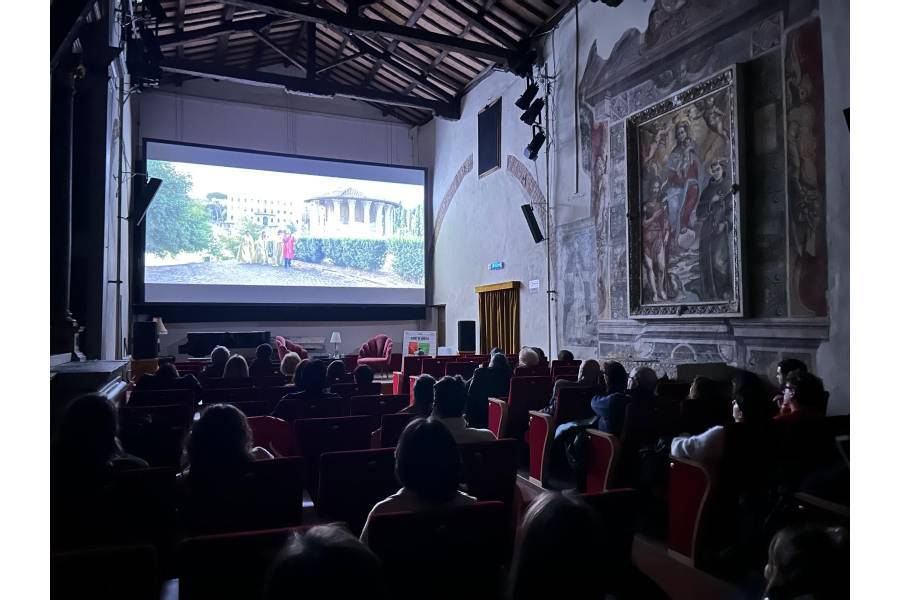
This year, on November 22nd, cinemas across five continents presented some of the most exciting European arthouse films of recent years, including premieres and special screenings in countries where many of these titles have little or no theatrical distribution. For local audiences, some events offered a rare — and sometimes the only — chance to discover these films on the big screen.
This year’s edition brought together around 700 cinemas in 52 countries, including 13 countries joining the initiative for the first time — a new record!
A few highlights from this year’s edition:
-
In South Korea, the European Arthouse Cinema Day turned into a five-day festival in Seoul brought together approximately up to 2,600 visitors.
-
In Spain, a special screening of Rose, followed by a discussion with Sandra Hüller, was live-streamed to more than 25 cinemas across the country.
-
In Italy, the Bertani sisters, Ambassadors of the CInema Day and directors of Le Bambine (Mosquitoes) met audiences during a mini-tour across four cities.
- In Central Asia, cinemas in Uzbekistan and Kazakhstan presented European classics: Mike Leigh’s Life Is Sweet in Tashkent and Polish classic Andrzej Wajda’s Innocent Sorcerers in Almaty.
13 new countries joined the initiative this year
This year, the European Arthouse Cinema Day welcomed participants from 13 countries for the first time:
-
Europe: Estonia, Kosovo, North Macedonia and Romania
-
Asia: India, Japan and Kazakhstan
-
Africa: Côte d’Ivoire, Ethiopia and South Africa
-
Middle East: Israel
-
Central and South America: Brazil and Mexico
Ambassadors & Patrons
This year, 10 international ambassadors joined the European Arthouse Cinema Day in celebrating European arthouse cinema: Pedro Almodóvar (Spain, Amarga Navidad); Valentina & Nicole Bertani (Italy, Le Bambine / Mosquitoes); Léa Mysius (France, Histoires de la nuit); Faraz Shariat (Germany, Prosecution); Isabelle Stever & Anna Melikova (Ukraine/Germany, I Rarely Wake Up Dreaming); Anca Damian (Romania); Boots Riley (United States, I Love Boosters); and Rodrigo Sorogoyen (Spain, The Beloved).
The initiative was also supported by six European Patrons:
- Sabine Verheyen (EU), Vice-President of the European Parliament, responsible for the LUX Audience Award
- Catherine Pégard (France), Minister of Culture
- Wolfram Weimer (Germany), Federal Government Commissioner for Culture and the Media
- Marta Cienkowska (Poland), Minister of Culture
- Nela Riehl (EU), Member of the European Parliament and Chair of the Committee on Culture and Education (CULT)
- Emma Rafowicz (EU), Member of the European Parliament and Vice-Chair of the Committee on Culture and Education (CULT)
Full interviews with the Arthouse Cinema Day ambassadors — discussing their films, creative processes and the themes that inspire them — are available on the CICAE YouTube channel. An interview with Isabelle Stever and Anna Melikova about their upcoming film I Rarely Wake Up Dreaming, which premiered on 22 November in Berlin and Reykjavík, is also available here.
Events & Highlights
From special screenings and filmmaker Q&As to workshops, festivals and international collaborations, cinemas around the world marked European Arthouse Cinema Day in their own way. Here are some highlights from this year’s edition.
In Berlin, City Kino Wedding screened the Dardenne brothers’ The Child (L’Enfant) with German audio description for blind and visually impaired audiences, in collaboration with Deutsche Hörfilm and the French Film Week, alongside a dedicated workshop. At Babylon Kreuzberg, the Berlin premiere of I Rarely Wake Up Dreaming was followed by a discussion with ambassador and director Isabelle Stever and screenwriter Anna Melikova.
In France, Le Navire cinema in Aubenas hosted two preview screenings as part of the Les Rencontres des Cinémas d’Europe festival, followed by live-streamed discussions with Du Fioul Dans les Artères director Pierre Le Gall and Call Me Queen actor Eliane Umuhire.
In Indonesia, Jakarta Film Week presented “Europe x Southeast Asia Connects!”, exploring European–Southeast Asian co-productions. The programme featured Imago by Déni Oumar Pitsaev, a discussion with filmmaker and anthropologist Aryo Danusiri, and a selection of short films.
In Bangladesh, two days of events in Dhaka and Mymensingh combined screenings, traditional food and an online masterclass with French architect Jean-Marc Lalo. The programme, organised with the International Academy of Film and Media and the Bangladesh Film Archive, also featured Pedro Almodóvar’s All About My Mother.
In Belgium, Cinéma Galeries in Brussels welcomed director Teodora Ana Mihai for a screening of Heysel 85, followed by a discussion moderated by Cine Club Bruxelles and an informal gathering.
In Hungary, TISZApART Cinema brought together audiences of all ages with a film music concert, discounted student screenings, premieres, live sand animation and a quiz, alongside food and drinks.
In Rwanda and Ethiopia, Mohamed Kordofani’s Goodbye Julia reached audiences at Playlab Arthouse in Musanze and Cine Mayaka in Kigali, and premiered at Videobet Cinema in Addis Ababa.
In Poland, Kino Paradox in Kraków offered a full day of European cinema and creative activities, from screenings of Carlos Saura’s Cría cuervos and Louis Malle’s Elevator to the Gallows to a children’s bird-painting workshop and a 16mm filmmaking workshop.
In Tokyo, Normal Screen, an independent queer film and arts initiative led by curator Sho Akita, hosted an informal gathering with EACD ambassador Faraz Shariat, bringing local audiences together for an exchange on cinema, queer perspectives and filmmaking.
In the UK and Ireland, two local premieres showcased films awarded at the 2025 Berlinale CICAE Awards. In Dublin, CICAE member Ingrid Machado presented Faraz Shariat’s Prosecution, while in Oswestry, Tatenda Jamera introduced On Our Own.
These are just a few snapshots of this year’s celebrations. Across countries and continents, cinemas and partners brought European arthouse cinema to life through screenings, encounters and exchanges.
We want to hear from you!
You contributed in this year’s European Arthouse Cinema Day – now we’d love to hear how it went! What worked particularly well, and what could be improved for future editions?
We invite all participating cinemas and partners to complete our short evaluation survey using the link below. Your feedback is essential to help us assess the initiative’s impact and shape the next edition.
The survey takes just 3–5 minutes to complete.
| Click here for the Questionnaire |
Looking ahead to 2027
More information about our activities in 2027 will be shared soon — so keep an eye on the CICAE website!
Upcoming initiatives include Berlinale meet-ups, Arthouse Cinema Training, Arthouse Cinema Awards, new workshops and resources for cinemas — and, of course, the next European Arthouse Cinema Day.