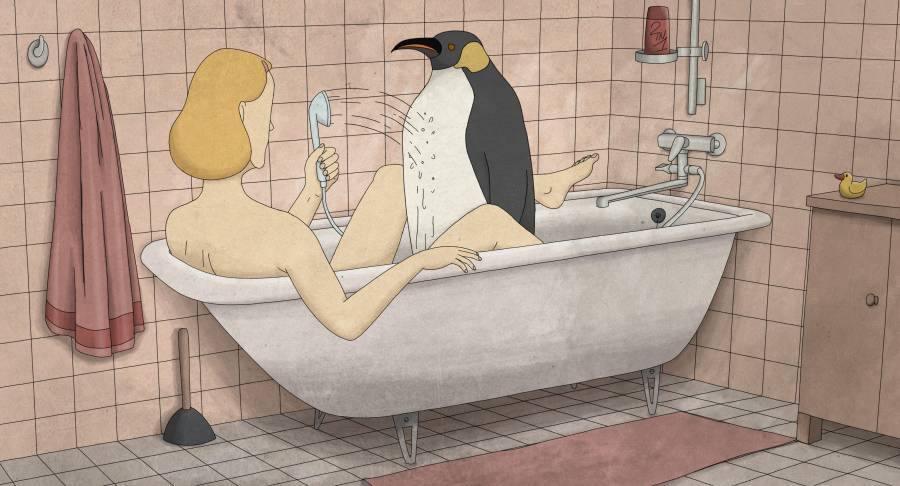
Known for his unique blend of absurdist humor and precise visual storytelling, Jancis returns with a new 2D drawn animation that explores relationships, responsibility, and letting go. Penguin tells a story of a woman who one day receives a unique gift from her partner who has returned from his trip to Antarctica. The gift causes a change in their relationship that is difficult to cope with.
While the film story and visual world are inspired by early horror cinema of the 1920s and 1930s, Penguin touches on contemporary concerns ranging from personal relationships to political irresponsibility and climate change.
Penguin continues Jancis’ signature hand-drawn animation style, familiar from films such as Cosmonaut (2019), Piano (2015), and others, while developing a distinctive visual identity in collaboration with the film’s art directors. “We were inspired by the world of Edward Hopper’s paintings,” says Jancis. Graphic backgrounds were created by his long-time collaborator Vladimir Lechiov, while Gyopár-Orsolya Buzási shaped its evocative world of colour, light and shadow.
The original orchestral score is composed by Marc Marder, known for his collaborations on several Cannes-selected fiction features. His score for Penguin draws on 1930s genre film influences, adding a classical dramatic layer to the contemporary narrative. The main character is voiced by Estonian opera singer and actress Juuli Lill, with a surprise cameo by French actress Rebecca Marder. Sound design is created by Horret Kuus, who has previously collaborated with Jancis on several projects.
The idea for Penguin had accompanied Jancis for many years, following a bizarre personal encounter with an emperor penguin in 2005. Over time, it developed into a story about a woman struggling with a shift in her relationship. “Developing the story, I asked myself what I would do in her situation. Knowing your former life has become impossible, yet trying to adapt to the new reality would feel like an excessive sacrifice. The sense of responsibility and guilt make it hard to leave your partner behind. The solution she finds is one I would likely choose myself,” says the director.
Production of Penguin began at the end of 2024 in the Estonian film studio Rebel Frame. The film is produced by Kadriann Kibus and creative producer Sergo Kibus, in co-production with La Clairière Ouest (France) and with the participation of ARTE France. Production was supported by the Estonian Film Institute, the Cultural Endowment of Estonia, the Film Fund of Estonian Islands, Pictanovo with the support of the Hauts-de-France Region, and CNC. The film is distributed by Pentacle Productions.
Producer Kadriann Kibus notes that Penguin marks Rebel Frame’s continued collaboration with Kaspar Jancis, alongside development of his adult animated episodic series Adult Bedtime Stories, presented at the Annecy MIFA pitches in 2025.
Alongside Penguin, Rebel Frame’s other competition entry at Annecy is the award-winning Winter in March by Natalia Mirzoyan.
The studio emphasizes its continued commitment to artistic animation that engages with complex contemporary themes. In a time of increasing economic and political pressure on cultural production, Rebel Frame expresses hope that independent animation can keep on thriving to provoke dialogue and inspire audiences.