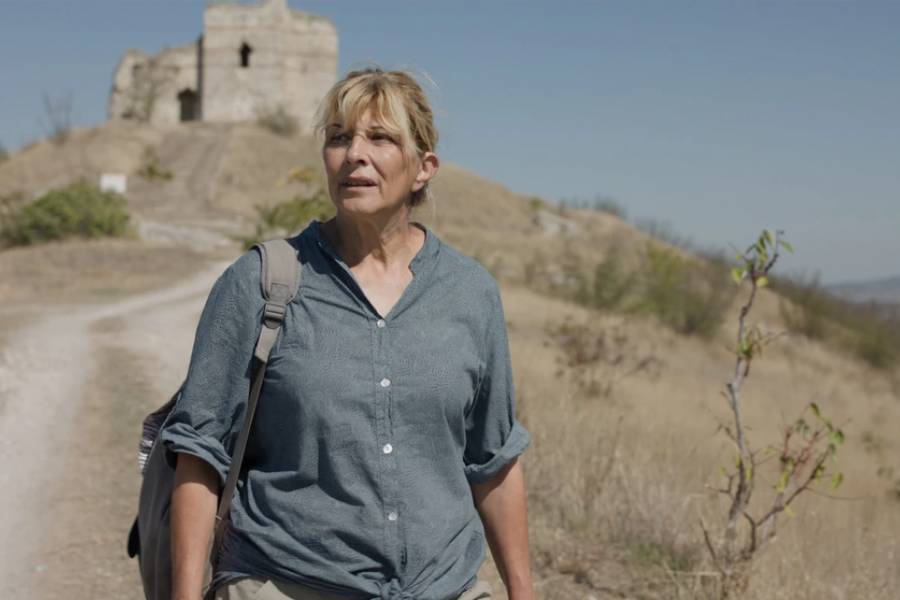
Set in a remote region where Bulgaria, Greece and Türkiye meet, The Dreamed Adventure follows Veska, an archaeologist working on excavations near the border. Her routine life takes an unexpected turn when she encounters Saïd, an old acquaintance she has not seen for many years. What begins as a chance reunion gradually draws Veska into a series of events connected to smuggling networks and hidden personal histories. As the story unfolds, the film explores themes of trust, memory, friendship and the lingering influence of the past. Rather than relying on conventional suspense, Grisebach allows the narrative to develop through observation, conversation and the relationships between her characters.
One of the most notable aspects of the production is its commitment to realism. Like many of Grisebach’s earlier works, The Dreamed Adventure features a cast made up largely of non-professional actors. The lead role of Veska is played by Bulgarian actress Yana Radeva, while Saïd is portrayed by Syuleyman Alilov Letifov. The director spent considerable time in the border region before filming, developing the project through extensive observation and collaboration with local residents.
During the Cannes press conference and in interviews published by the festival, Grisebach discussed her unique approach to filmmaking. Reflecting on the production process, she explained: “What I like is this tension between what we write and what happens.” Rather than working from a rigid screenplay, she described creating situations and allowing real locations and real people to influence the final shape of the story. According to the director, the film grew out of an openness to unexpected encounters and discoveries during production.
Grisebach also spoke about her casting philosophy, which has become a defining feature of her work. “It wasn’t a question of ideology,” she said regarding her preference for non-professional performers. “It was simply because it made sense with my way of working.” She revealed that the actress who plays Veska was discovered by chance, explaining: “We met Yeva on the street. I was impressed by her elegance and charisma.”
Born in Bremen in 1968, Valeska Grisebach first gained international recognition with her debut feature Be My Star / Mein Stern in 2001. She followed it with Longing / Sehnsucht in 2006, a drama that screened in competition at the Berlin International Film Festival. Her third feature, Western (2017), premiered in Cannes’ Un Certain Regard section and earned widespread acclaim for its subtle examination of human relationships and cultural encounters. Throughout her career, Grisebach has been associated with the Berlin School movement, although her films often stand apart because of their strong emphasis on improvisation and observation.
The Dreamed Adventure was produced by Komplizen Film in Germany in collaboration with partners in France, Bulgaria and Austria, reflecting the international nature of the story itself. Filmed in the landscapes of southern Bulgaria, the production captures a region rarely seen in international cinema.
Speaking about her broader philosophy of filmmaking, Grisebach offered a remark that perhaps best summarizes both the film and her career: “I believe that making films is above all about making contact with people. And sometimes, it’s about not knowing everything.” That openness to discovery lies at the heart of The Dreamed Adventure, a film that brought one of Europe’s most patient and observant filmmakers back to the Cannes competition after nearly a decade.
Credits
The Dreamed Adventure (Germany, France, Bulgaria, Austria)
Directed by Valeska Grisebach
Produced by Komplizen Film Production
Coproduced by Kazak Productions, Miramar Films, Panama Films, Valeska Grisebach, New Matter Films, ARTE France Cinéma, ZDF/ARTE, and in collaboration with ARTE Franc
Supported by Der Beauftragte der Bundesregierung für Kultur und Medien, Medienboard Berlin-Brandenburg, Filmförderungsanstalt, Deutscher Filmförderfonds, Mitteldeutsche Medienförderung, Creative Europe MEDIA, Aide aux cinémas du monde, Centre national du cinéma et de l’image animée, Institut Français, the Bulgarian National Film Center, Österreichisches Filminstitut und ÖFI+, Filmfonds Wien