Not till a hot January: The One World Documentary Film Festival focuses on (not just) the effects of the climate crisis in films
Festivals 03-02-2020Drying rivers, parched fields, and empty wells. Climate change is starting to affect even our immediate surroundings. This is one of the reasons why this issue is being discussed by experts, in the media, by politicians, and often even amongst friends at the pub. The various manifestations of the environmental crisis within the context of the local landscape, as well as the role humans play in it, will also be among the topics addressed at this year’s 22nd One World International Human Rights Documentary Film Festival, which will take place from 5 to 14 March in Prague and subsequently in thirty-five other cities and towns throughout the Czech Republic.
When William Shakespeare coined the phrase “not till a hot January”, he had no inkling that this phenomenon might actually occur one day. Currently, however, it quite accurately describes one of the main results of climate change – continuously rising temperatures. The increasingly warmer climate in combination with poor soil management has resulted in a landscape that is incapable of retaining water. According to One World’s director, Ondřej Kamenický: “By screening films that are (not just) about the climate crisis, we want to show the global dimension of the entire problem while focusing chiefly on its impact at the local level. We not only want to draw attention to the issue, but to also look for a solution and find inspiration in the specific events organised in each of the thirty-seven towns including One World in Brussels where the festival takes place. In short, we don’t want to wait till a hot January comes along.”
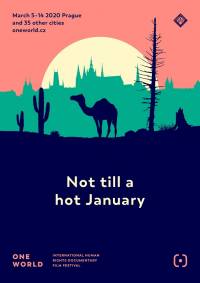
For the third year in a row, Studio MT (Matyáš Trnka in collaboration with Matěj Růžička) have been entrusted with creating the festival’s PR campaign. The stag we see running against the backdrop of a burning horizon in the festival trailer gradually metamorphoses into a camel – this year’s key visual element. “Withered trees, no forests, bare plains, hot and arid – that is how the Czech landscape might look if steps are not taken to deal with climate change. We are offering a glimpse of such a horizon not only in the case of Prague, but also for all of the other towns where the festival is taking place. In fact, we made an individualised visual for each location in question. In addition, we tried to ensure that both the poster and the video trailer are accessible even to people with compromised vision. The bold and highly contrasting colours were therefore chosen not only to stress the subject but also to make the visuals intelligible to as many people as possible,” explains Matyáš Trnka, the campaign’s author.
The UnEarthed category publicises environmental films
One World has been addressing environmental themes since more or less the time the festival was first established. For the past three years, the documentaries matching this description have been included in the UnEarthed category, which just happens to be the festival’s most important thematic grouping this year. The included films look at topics such as climate change, energy, and pollution. One of them is Apolena Rychlíková’s new documentary, The Czechs Are Excellent Mushroom Pickers, which tracks these issues in the Czech Republic through extra-terrestrial eyes. Director Meng Han shot her documentary Smog Town in Langfang, a Chinese city near Beijing, which is considered to be one of the world’s most air-polluted locations. In it, she considers questions such as what life is like in a city without a sky and what local politicians have to say about it. Pollution is also the main theme of the Canadian film There’s Something in the Water. The well-known actress and activist Ellen Page and the director Ian Daniel visit with women in the agricultural regions of Nova Scotia, who are battling industrial companies in order to save the local landscape, their community and, most importantly, the future. The documentary Sovereign Soil looks at life in a landscape that has remained almost untouched by humans. This film by the Canadian director David Curtis is an ode to the beauty of the remote Yukon Territory and the local inhabitants of the town of Dawson, who strive for food self-sufficiency through alternative farming methods in what are often unfavourable conditions.
The festival’s virtual reality section, which is entirely focused on ecology and nature, will allow visitors to travel to forests, to the desert, and even to the highest peaks of an iceberg. All of the virtual reality exhibits will be housed at the DOX Centre for Contemporary Art in Prague’s Holešovice district, where visitors will also find special installations with themes revolving around nature. The Ayahuasca virtual reality experience provides a glimpse of the vivid psychedelic visions of living nature one sees after drinking the hallucinogenic plant-based tea known as Ayahuasca. The Songbird project is actually an expedition tracking the recently extinct ‘ōʻō (Moho bird), while Le Lac takes the spectator to Lake Chad, which is in the process of drying up and vanishing.
In addition to the UnEarthed category, One World 2020 includes the three traditional competitive categories (the Czech Competition, the International Competition, and the Right to Know Competition), and eleven additional thematic categories. This will be the third year of the special discussion programme entitled Talking Cinema. Experts in various subjects will come to Prague and present lectures to accompany selected film screenings. This year, Leilani Farhani, a United Nations Special Rapporteur, will discuss the worldwide problem of inaccessible housing, and the activist Amon Yiu Yeuk-wa, a member of the Demosistō political movement in Hong Kong, will talk about the current political situation in a region that has been fraught with protests and demonstrations for the past six months.
One World: Balanced, Ecological, and Harmoniously Eco-Friendly
The festival organisers think about the environment not only when they are selecting the films for the programme, but also when preparing for the festival and during it. Some steps are a given, such as conserving both energy and water, recycling waste in all of the offices as well as at all of the cinemas, limiting the volume of printed materials, and using eco-friendly paper. This year, the festival catalogue is being replaced by a brochure that uses only half the amount of paper, and all information is being published on-line. Furthermore, the festival strives to collaborate only with partners who are just as careful with regard to the environment. The same level of consideration applies when it comes to transport for the festival’s guests – mainly bus and rail transport are offered, and in those cases when flying is unavoidable, One World provides financial compensation for the resulting carbon footprint. This year, the festival is also offering its guests transport from the airport using Prague’s integrated transport system. “Guides will meet our guests at the airport and accompany them on public transport to their hotel or the Langhans Audience Centre,” explains Sabina Solničková, One World’s Head of Guest Services. She goes on to add that if a guest prefers to be transported around Prague by car, the festival partly uses electric cars some of the time. A change in the means of transport has also been implemented with respect to the delivery of film copies – as a matter of fact, the majority of them are only in digital format. Some things have remained the same however – the vegetarian buffets and the use of the festival’s own glasses and dinnerware make it possible to minimise the amount of generated waste.
In addition to being eco-friendly, the festival also considers it important to support filmmakers and local creativity in countries where there are non-democratic and dictatorial regimes – a quarter of all of this year’s films were made by local makers. Just as significant is the festival’s effort to ensure the balance between male and female directors.
One World for All
Over the past three years, accessibility to the festival for individuals with disabilities has become the norm and this year will be no different as One World strives to achieve universal accessibility. As explained by Mariana Chytilová, the festival’s accessibility expert: “We don’t focus only on some particular group of people with disabilities like so many other cultural events do, but instead want to implement measures that make the festival experience available to the broadest possible spectrum of visitors.” All of the documentaries screened in Prague, including those in Czech, will have Czech captions for people who are deaf or hard of hearing. Just like last year, headphones with audio commentaries describing what is happening on the screen will be available at screenings of four different films for people who are blind or have vision loss. In addition, the festival includes three relaxed screenings which have a looser organisation that may be more comfortable for people who have mental disabilities or difficulty concentrating. And last but certainly not least, we aim to increase the number of places accessible to audience members who need a wheelchair or have other mobility issues.
One World in Schools
“To the cinema instead of class!” will be heard in many schools while the festival is underway. One World is organising special afternoon screenings for schools in all of the towns where the festival will be held. Just like in previous years, we have selected a range of films that will ensure the interest of all age categories. For primary school students, we have chosen three series of short films covering diverse subjects, including bullying, family relationships, and environmental issues. The selection for secondary school students consists of two short and two feature length films. One of them, Mai Khoi and The Dissidents, is about a Vietnamese singer who was forced to leave her homeland and its uncompromising censorship because of her anti-regime lyrics. Another, entitled For Sama, is set in Aleppo, the centre of the armed conflict in Syria, and has recently received an Oscar nomination. All of the films shown during the school screenings are followed by a discussion. Schools wishing to participate must register for the screening in advance – in Prague, via the JSNS.CZ portal during the first week in February, and in the other towns, through the local festival coordinators. For more information, see jsns.cz/festival.
East Doc Platform
The East Doc Platform (March 7–13, 2020) during One World IHRDFF offers free open programme in English for industry professionals and documentary film lovers: discussions, masterclasses, presentation Czech Docs… Coming Soon and East Doc Forum – prestigious central pitch for feature-length projects in development and early production stage. The East Doc Platform is the largest co-production, funding and distribution platform tailor-made for Central and Eastern European documentaries, every year connecting filmmakers and key decision makers – producers, broadcasters, distributors and festival programmers from around the world. Internationally successful titles, such as Over the Limit, When the War Comes, The Sound Is Innocent, Sofia’s Last Ambulance, Village Without Women, Ukrainian Sheriffs, The Russian Job and Brothers, were presented at the East Doc Platform. Film professionals who want to attend the industry programme can buy the industry accreditation until February 14.
We will publicise the festival programme as well as the names of our international guests at the accreditation press conference scheduled for Tuesday, 18 February at 10 am, which will take place at our audience centre in the Tibet Open House (Školská 28). You should be receiving an invitation from us soon via email.
Additional information, as well as this year’s visuals, are available for download at www.jedensvet.cz.
One World in the Regions 2020
|
Benešov |
23–28 March |
|
Boskovice |
17–22 March |
|
Brno |
20–27 March |
|
České Budějovice |
16–20 March |
|
Český Krumlov |
12–14 March |
|
Děčín |
25–28 March |
|
Hradec Králové |
17–20 March |
|
Jablonec nad Nisou |
23–26 March |
|
Karlovy Vary |
18–22 March |
|
Kladno |
1–3 April |
|
Liberec |
23–29 March |
|
Louny |
31 March – 4 April |
|
Mladá Boleslav |
6–9 April |
|
Nymburk |
1–4 April. |
|
Olomouc |
16–21 March |
|
Opava |
23–27 March |
|
Ostrava |
26 March – 3 April |
|
Pardubice |
17–21 March |
|
Pelhřimov |
1–5 April |
|
Pilsen |
23–28 March |
|
Police nad Metují |
26–29 March |
|
Polička |
2–5 April |
|
Rožnov pod Radhoštěm |
30 March – 2 April |
|
Řevnice |
26–28 March |
|
Sušice |
31–4 April |
|
Tábor |
2–5 April |
|
Tišnov |
19–21 March |
|
Třebíč |
20–22 March |
|
Třinec |
19–22 March |
|
Uherské Hradiště |
23–27 March |
|
Ústí nad Labem |
23–27 March |
|
Ústí nad Orlicí |
28 March – 4 April |
|
Vsetín |
30 March – 3 April |
|
Zlín |
30 March – 2 April |
|
Znojmo |
24–27 March |
Films in the UnEarthed Category
Copper Mountains (Finland; Carolin Koss, 2018)
The Czechs are Excellent Mushroom Pickers (Czech Republic; Apolena Rychlíková, 2019)
Ice on Fire (Norway / Germany / United Kingdom / Switzerland / United States / Iceland / France / Croatia; Leila Conners, 2019)
No Gold for Kalsaka (Burkina Faso / Germany; Michel K. Zongo, 2019)
Smog Town (China; Meng Han, 2019)
Sovereign Soil (Canada; David Curtis, 2019)
Sumercé (United Kingdom; Victoria Solano, 2019)
The Last Male on Earth (Netherlands; Floor van der Meulen, 2019)
The Red Line – Resistance in Hambach Forest (Germany; Karin De Miguel Wessendorf, 2019)
The Secret Lives of Pigs (Norway; Ola Waagen, 2019)
There’s Something in the Water (Canada; Ellen Page, Ian Daniel, 2019)
One World Interactive
-22.7°C (France; Jan Kounen, 2019)
A Violated Dream: The Colombian No Man’s Land (Colombia; Elliot Graves, 2019)
Animalia Sum (Brazil / Iceland / Germany; Bianca Kennedy and The Swan Collective, 2019)
Anthropocene VR (Canada; Nicholas De Pencier, Jennifer Baichwal, Edward Burtynsky, 2019)
Ayahuasca (France / Luxembourg; Jan Kounen, 2019)
Cycling Across Barriers (Cyprus; Elliot Graves, 2018)
Dark Origins: Mephisto (United Kingdom; Calum Bowden, 2019)
Dreams of the Jaguar's Daughter (United States; Alfredo Salazar-Caro, 2019)
Le Lac (Chad / Kenya / Zimbabwe; Naysha Kadandara, 2019)
Museum Alive with David Attenborough (United Kingdom; Elliot Graves, 2019)
Songbird (Denmark / United Kingdom; Michelle and Uri Kranot, Lucy Greenwell, 2018)
The Wetland (Romania; Ioana Mischie, 2018)
Whispers (Poland; Jacek Naglowski, 2019)

4th ANNUAL HISTORY FILM FESTIVAL®, PRESENTED BY Istra Film, ANNOUNCES 2020 DATES, September 8 - 12, AND CALL FOR SUBMISSIONS
Festivals 03-02-2020RIJEKA, Croatia – January 20, 2020– For the 4th year, the History Film Festival presented by Istra Film, will bring creators, diverse audiences, and the industry together in Rijeka, Croatia during the annual storytelling festival running September 8-12, 2020.
History Film Festival is a unique international festival of historical documentary films which will take place in Rijeka (Croatia) from September 8 to 12, 2020. History Film Festival aims at offering viewers and film experts an insight into contemporary film and TV production of historical documentary films, at the same time providing a place where film professionals can meet and share their creative ideas for future projects.
The programme of 2020 HFF consists of a competition programme and special thematic programmes (documentary hommage to Federico Fellini, Asterix's 60th birthday, masterclasses, panels, exhibitions).
From its first edition History Film Festival cherishes and extends its collaboration with documentary filmmakers from all over the world. All of the films showcased at History Film Festival tell history in exciting, often unusual, sometimes very intimate and visually attractive ways, but they also shed revelatory light upon the present which is exactly one of the aims of History Film Festival. These films show all the talent and passion of documentarists who always seem to find innovative and creative techniques of shaping history into exciting story. Furthermore, documentary filmmaking based on the archives and research is essential for the understanding of the past and the present, especially as an answer to the fake news era.
In 2020, the City of Rijeka is caring the title of the European Capital of Culture and History Film Festival which will be held from September 8-12, 2020 is going to be part of the official programme of ECoC. In 2020 we plan to showcase documentaries which confirm how history can be extremely exciting and promote diversity, tolerance, intercultural dialogue and reconciliation as a way of exceeding the past and building a better future.
This year the festival will be especially focused on films connected to the following subjects:
- women as film authors or women as heroines in human history
- migrations
- re-thinking totalitary regimes and politics (especially Tito)
- Asterix
- Federico Fellini
Documentary films, regardless of the year of production, can be submitted on Film Freeway at the following link: https://filmfreeway.com/HistoryFilmFestival
The official deadline for submissions is February 10, 2020. For all queries concerning the festival please contact us at: This email address is being protected from spambots. You need JavaScript enabled to view it.
The 2020 Festival is set to build on the momentum from last three editions, which set the bar high. The past line-ups featured breathtaking docs like Oscar winner O.J.: Made in America, Sundance Award Winner Rumble: The Indians Who Rocked the World, Oscar nominee Touch of an Angel and amazing European stories such as Legacy, Hotel Jugoslavija and Aliona Van Der Horst's Love is Potatoes.
The Festival is curated by the programming team including Director and Head of Programming Bernardin Modrić, producers Tiha Modrić and Dejan Bojc, and a team of professional associates.
EDITORS NOTE: Images from History Film Festival can be found here for any photo or social needs: http://historyfilmfestival.com/en/media-2019/
WARSAW: FNE has teamed up with the Brussels based team of the International Union of Cinemas (UNIC) to bring you regular updates on EU cinema policies that impact all industry professionals across Europe. Click here for FNE UNIC EU Cinema Policy Update.
EU Copyright Directive
/01: “Stakeholder dialogue” meetings on Article 17 of the DSM Directive – EAO Newsletter
In October and November 2019, the European Commission organised three “stakeholder dialogue” meetings, as required under Article 17(10) of the recently-enacted Directive on Copyright in the Digital Single Market. These meetings were aimed at discussing best practices for cooperation between online content-sharing service providers and rightsholders.
EU Multiannual Financial Framework (MFF) 2021-2027
25/01: Invitation letter by President Charles Michel to the members of the European Council ahead of their meeting on 20 February 2020 – Council of the EU
Digital taxation
21/01: Croatian presidency ready to prepare negotiations on digital taxation – EU2020HR
The first Economic and Financial Affairs Council under Croatian Presidency was held today in Brussels. The ministers discussed digital taxation, and financial and economic aspects of the European Green Deal.
Council of the EU
23/01: Croatian Presidency outlines priorities to EP committees – European Parliament
Ministers are outlining the priorities of the Croatian Presidency of the Council of the EU to parliamentary committees, in a series of meetings.
European Commission
27/01: (Document) The European Commission’s 2020 work programme – Contexte (Article FR)
Context publishes a preparatory version of the list of legislative texts and other initiatives planned by the von der Leyen Commission for its first year.
European Parliament
15/01: Number of members in Parliament’s committees to change after Brexit – European Parliament
MEPs voted on the post-Brexit size of Parliament’s 20 committees and two subcommittees.
EU Digital Services Act
15/01: Digital Services Act: adapting commercial and civil law rules for commercial entities operating online – European Parliament Legislative Observatory
16/01: Digital Services Act: Improving the functioning of the Single Market – European Parliament Legislative Observatory
16/01: Digital Services Act and fundamental rights issues posed – European Parliament Legislative Observatory
13/01: What the EU Should Put in the Digital Services Act – Center for Data Innovation
Events
4 February: European Audiovisual Observatory conference – “TV and film production in Europe –
the state of independence?”, Brussels
4 February: Seminar: "Towards a more effective copyright enforcement on digital content sharing platforms: State of the art and proposals on Automated Content Recognition services”, Permanent Representation of France to the EU, Brussels
5 February: S&D Group JURI workshop on the civil liability regime for Artificial Intelligence, Brussels
10 February (TBC): Sixth European Commission copyright stakeholders’ dialogue, Brussels
18 February: UNIC conference at the European Parliament, Brussels
19-20 February: European Parliament CULT Committee meeting, Brussels
24 March: Digital Services Act conference: A new rulebook for the digital economy?, Brussels
TBILISI: The Georgian National Film Center has launched the 2020 competition for feature film minority coproductions. The deadline is 16 March 2020.
COMPETITION FOR FINANCING 2020 FEATURE-LENGTH FICTION FILM CO-PRODUCTIONS BETWEEN GEORGIA AND FOREIGN COUNTRIES
Press releases 02-02-2020The purpose of the Competition is to finance feature-length fiction film co-productions between Georgia and foreign countries, with the funds allocated from the State Budget of Georgia.

ZAGREB: Croatian minority coproduction Chris the Swiss directed by Anja Kofmel will be released by DocsBarcelona Distribution in 70 Spanish cinemas on 6 February 2020.

Alternative distribution platform KineDok and Prague screening room Screenshot have prepared a month long journey (2-27 February 2020) through European documentary films in 15 screenings.
BORDEAUX: Titles from Croatia, the Czech Republic, Estonia, Georgia, Poland, Romania and Hungary are among the 66 projects from 20 countries selected for the 22nd edition of Cartoon Movie, which will take place in Bordeaux from 3 to 5 March 2020.